Dr. Jared Bryson Joins The McGraw Show to Discuss Support for Tornado Victims
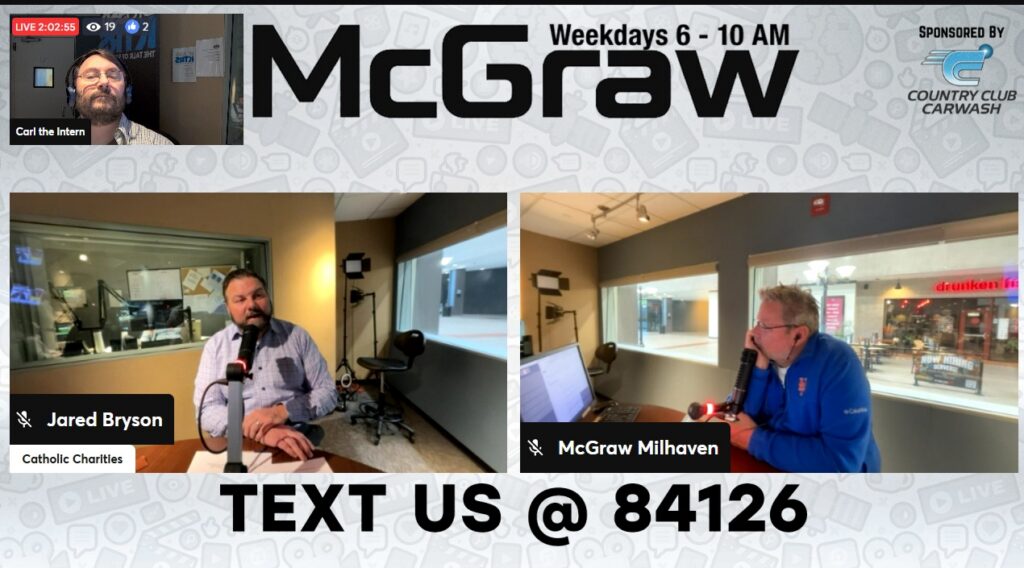
Dr. Jared Bryson, President and CEO of Catholic Charities of St. Louis, joined McGraw Milhaven on The McGraw Show on KTRS to discuss Catholic Charities’ ongoing work supporting tornado victims. In the interview, Dr. Bryson shared how Catholic Charities continues to walk with families through long-term recovery, housing support, case management, and its House to Home program.
McGraw Milhaven:
Let’s have a conversation with one of the good ones, President of Catholic Charities, Dr. Jared Bryson. Jared, welcome back to The Big 550 KTRS.
Dr. Jared Bryson:
Great to be here. Thanks, McGraw.
McGraw:
You were here a year ago just as the tornadoes hit, and you all are on the front lines with things like this. Give people a sense of what Catholic Charities does and how you exist.
Dr. Bryson:
Catholic Charities is a womb-to-tomb organization. We take care of the needs of those who are most marginalized and find themselves in critical places in their lives.
In particular around the tornado, we are not just an immediate-response organization. We are a long-term recovery organization. We stay with people all the way through recovery, which can take several years.
McGraw:
You all support many local charities throughout the spectrum and throughout all stages of life.
Dr. Bryson:
That’s right — from St. Patrick Center, Cardinal Ritter Senior Services, Queen of Peace Center, and many others. Big and small.
McGraw:
Talk about the tornado specifically. It’s been a year, and I’m sure it has strained some of your resources. What have you seen and what have you been able to do?
Dr. Bryson:
We’re now in the transition from immediate response to longer-term recovery. We’ve moved from 97 houses we were working through to 179 since January. It’s a long process to go through assessments.
We have 137 direct clients and about 2,200 to 2,300 people impacted as part of the work. We’ve completed 383 home visits in support of those families. These assessments take time as we figure out what can be done and then work through the recovery process.
There are also more than 40 active construction cases we’re working on right now, along with active case management to help move people through recovery. So far, nine impacted households have been completed. It just takes a really long time.
Someone said to me, “There are not enough bricklayers in five states to help us recover sometimes.” That gives a sense of how slow and difficult the process can be.
McGraw:
Some of these homes may not have been insured, and the economics are difficult. What happens now? Where do these people go? How do they rebuild?
Dr. Bryson:
That has been a real challenge. We’ve partnered with MHDC and others to help find and repair housing. We provide support for moving costs when families have to move somewhere else and then eventually move back.
We’ve done significant work in home repairs, and MHDC has allocated additional funding per house that we’re walking through. There is also immediate assistance: hotel stays, gift cards for essentials, and other support because families have lost so much.
We also have a House to Home program where people can adopt a family. Once a home is stable and a family can move back in, they may not have furniture, bedding, kitchen items, or other basic needs. Through House to Home, people can help re-anchor a family as they return.
We’ve also provided seasonal support, because families have gone through Christmas and other difficult moments. We’re dedicating a lot of resources to one neighborhood at a time, because the need is so significant.
McGraw:
Are you getting help from the federal or state government?
Dr. Bryson:
We get some support, though not always direct financial support. United Way has helped with case management. MHDC at the state level helps with some repair work. But overall, the support is still limited compared with the need.
McGraw:
How do you keep the faith? It’s a never-ending hole — the more you do, the more is needed.
Dr. Bryson:
One of the biggest challenges in the work of Catholic Charities is that there is always more need. We’ve gone from serving 92,000 people a year to 122,000 people a year, and that was not tornado-related.
It can be challenging to constantly see people at their lowest. But what keeps the faith and keeps hope for me is walking with each person who comes through our doors and seeing them start to make progress. You have to stay focused on that — walking with a family, helping them get back into a house, and seeing those individual success stories.
McGraw:
How can people help for STL Giving Day?
Dr. Bryson:
The recovery still continues, and we have limited funds as we work to help people get back on their feet. We are asking people to volunteer their time, adopt a family, and give generously — through their time, talent, and treasure.
People can go to ccstl.org and connect with our volunteer team to learn how to get involved.
McGraw:
Tell us more about the adopt-a-family effort.
Dr. Bryson:
It’s part of our House to Home program. As people move back into their homes, many have lost furniture, bedding, household goods, and other essentials. Through House to Home, people can adopt a family and help provide the items they need to make life stable again.
McGraw:
Jared, for people who want to find out more or help, where should they go?
Dr. Bryson:
Go to ccstl.org.
McGraw:
That is Dr. Jared Bryson, President and CEO of Catholic Charities. While you’re helping tornado victims, the other needs continue.
Dr. Bryson:
They do. Affordable housing, mental health, food insecurity, and workforce development all remain major needs in our community. And we always need volunteers.
McGraw:
Dr. Jared Bryson, one of the good ones. Thanks for coming in.
Dr. Bryson:
Thanks, McGraw.